
Gove County VINELink Coverage
Kansas VINE through VINELink receives custody information from participating county jails. It can report a custody status, the feeder facility, and changes such as release or transfer. Gove Sheriff also maintains an official VINELink referral page.
Coverage has a firm boundary. Kansas VINE does not cover Kansas Department of Corrections prison offenders, juveniles, or federal detainees. A Gove arrest can move across those boundaries. Once a person transfers to KDOC, use KASPER. A federal sentence belongs in the BOP locator, while federal pretrial or immigration custody may require other channels.
Search Gove County VINELink
Start with enough information to separate the person from similar names. A booking or offender identifier is especially useful when offered. VINELink is a one-person custody check, not a full recent-release list.
- Open the Kansas interface or call 1-866-574-8463.
- Select offender search and enter the person’s name.
- Add an offender or booking identifier when the interface permits it.
- Compare the displayed identifiers and physical facility.
- Open the correct detail and read the precise custody status.
- If released appears, save any reported date and time, then call the feeder jail.
Multiple matches require care. Compare the facility and identifiers rather than choosing the first similar name. If the result is absent, check spelling and ask Gove Sheriff which contract host held the person. A no-result alone does not establish release.
Identity matching should remain consistent across the whole check. Record the exact spelling used, the booking or offender number when one appears, and the facility name. Age or date of birth can help where lawfully displayed. Do not merge two records just because the names look alike. If Gove says Thomas held the person but VINELink shows a different jail, ask whether a transfer occurred and which agency now feeds the status. The host trail matters more than the county named in the original case.
The manifest capture from the Kansas VINELink search interface shows the official entry point for a specific-person search.
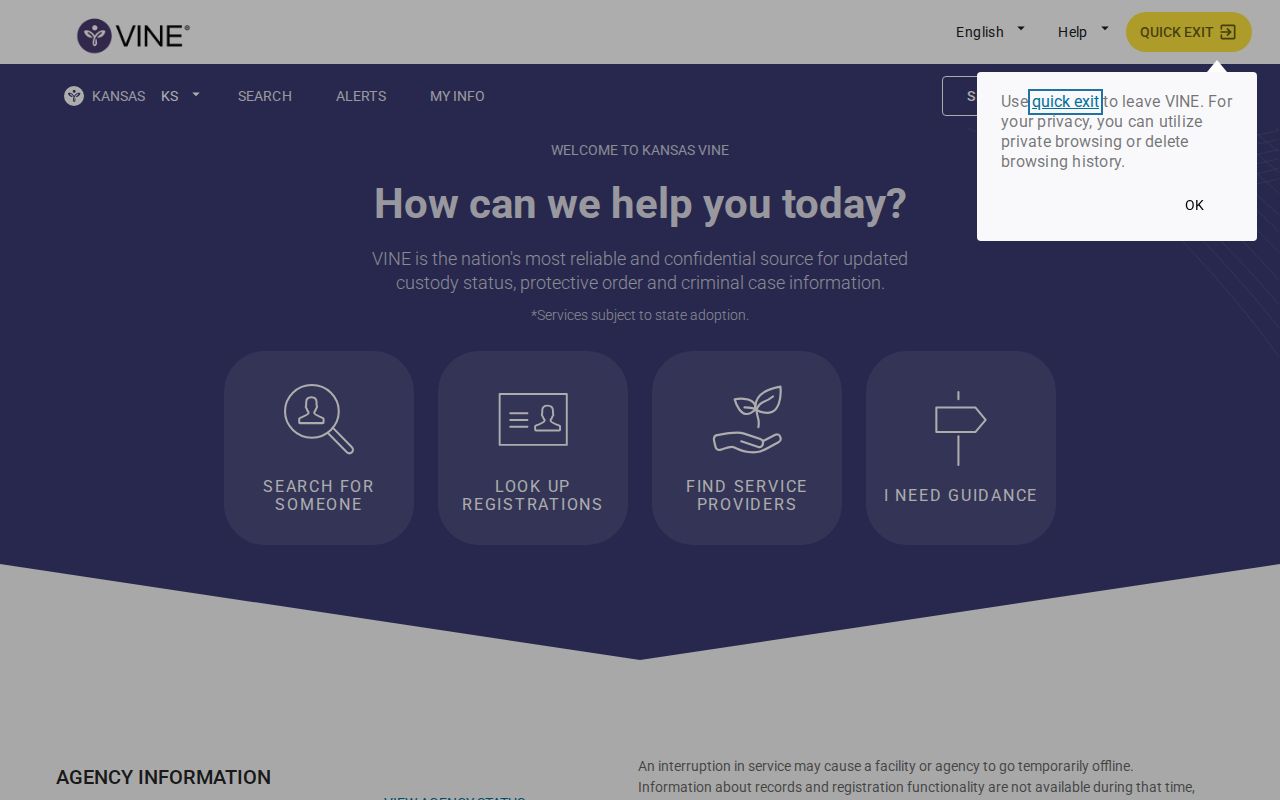
The interface is the starting point. The selected record and feeder-jail confirmation provide the useful custody context.
Read Gove VINELink Results
VINELink fields depend on the data supplied by a participating jail. Read the record literally and avoid adding meaning that the result does not state. A release status can show that the feeder recorded a change, while the host remains the source for whether the event was release to the community or transfer.
| Result element | How to interpret it |
|---|---|
| Name or offender identifier | Helps match the correct person and record. |
| Custody status | Reports the status sent by the participating jail. |
| Facility | Identifies the physical feeder, often Trego or Thomas for Gove. |
| Release or change time | Use the timestamp if displayed, then confirm it with the host. |
| Notification option | Starts registration for future changes on that matched record. |
Do not expect a KDOC anticipated release date in Kansas VINE. KASPER is the correct state-prison source. Likewise, the BOP inmate locator handles former federal prisoners and can show a federal release date. Custody type determines which result is meaningful.
A current result and a historical release record also serve different roles. VINELink is designed for custody status and notification. Gove and its host retain the underlying booking or event records subject to their custody and access rules. When an exact release authority, transfer destination, or booking document is needed, request that existing record from the proper agency rather than expecting the notification screen to supply a complete file.
Register Gove Release Notifications
Register only after opening the correctly matched person record. The service is free, voluntary, confidential, available around the clock, and offers operator language help. Channels currently offered may include phone, email, text, or in-app notifications, but availability can vary.
- Select notification or registration from the matched record.
- Choose a currently offered contact channel.
- Enter accurate contact information and complete the confirmation prompts.
- For telephone alerts, create the PIN requested by the system and keep it.
- Confirm that registration finished and retain the person and facility details.
- After an alert, contact the feeder jail if release versus transfer matters.
Kansas Legal Services explains that phone calls can repeat for up to 24 hours until the recipient enters the PIN to acknowledge the message. Its guidance says email registration does not use the phone PIN. Follow the current prompts and do not assume a fixed PIN length.
Keep registration details private. An alert is meant to inform the registered recipient of a status change. It is not a court disposition, release order, or complete custody history.
Test that contact details were entered correctly before relying on the alert. Email filters, phone settings, and changed numbers can interrupt delivery even when the registration itself remains active. Keep the confirmation shown by the service. If circumstances change, return to the matched record and follow the current interface for managing notification channels. Never assume that one registration follows the person into KDOC or federal custody, because those systems fall outside Kansas VINE coverage.
Why Gove VINELink Alerts Matter
Gove is unusual because its sheriff directs readers to VINELink while detainees are physically housed through Trego and Thomas counties. That makes notifications valuable, but it also makes facility interpretation essential. A person may leave one agency’s immediate control and remain confined elsewhere.
The Thomas County victim-notification page supports the Kansas phone line, 1-866-574-8463. The Kansas Attorney General’s primary landing page contains an apparent transposition of that number, while the current directory and Thomas material support the number used here. Verify live agency contact information when calling.
When an alert arrives, note the stated event and time. Then ask the host whether the person exited to the community or transferred to another jail, KDOC, ICE, USMS, or another custodian. That call turns a notification into a clearer custody account.
Confirm Gove VINELink Releases
VINELink depends on data reported by participating agencies. A feeder update may lag the underlying jail event. A spelling mismatch, transfer, or coverage boundary can also produce a confusing no-result. Do not treat silence as proof of release.
| Person’s custody type | Confirmation channel |
|---|---|
| Gove county-jail detainee | VINELink plus the Trego or Thomas host and Gove Sheriff. |
| KDOC prison offender | KASPER and KDOC records or sentence-computation contacts. |
| Federal prisoner | BOP inmate locator and, when needed, BOP records. |
| Immigration detainee | ICE locator within its limits and ICE direct contact. |
| Unclear destination | Ask the last known host for event type and receiving agency. |
For a named person whose trail spans more than one system, use the Gove County released inmate search. It combines host records, court disposition, KASPER, federal tools, and records requests without treating one database as universal.
Contact Gove Sheriff at 785-938-2250 when the physical host is unknown. Trego Detention can be reached at 785-743-5721, and Thomas Jail at 785-460-4570. Ask for the exact last custody event rather than a broad status guess.
Note: A VINELink “released” result should be confirmed when the destination or continued custody is important.
Gove Custody Terms Defined
Several short labels can hide major differences. Read each in the context of the reporting facility.
- Release
- A custody event that may mean departure to the community, but should be checked against the destination.
- Transfer
- A move from one custodian to another; it is not community release.
- Discharge
- The end of a sentence or supervision status in the system that reports it.
- Detainer
- A request or authority for another agency to take or continue custody.
A precise event label prevents the most common mistake in Gove County: assuming that leaving a host roster means leaving all custody.
“Still in custody” means a jail or correctional agency continues to hold the person. “Released” should be tied to the system reporting it. Someone released by Trego to Thomas has left one host but remains confined. Someone discharged by KDOC has reached a state-corrections status that Kansas VINE does not report. Using the agency name with the status makes each statement clearer and easier to verify.
VINELink also differs from a court record. A Gove County court docket can show bond, disposition, sentence, jail credit, probation, revocation, or discharge context. It may explain the authority for release, but it does not report the host jail’s exact physical exit. Use the court and feeder-jail event together when the alert wording is not enough.
For a state sentence, KASPER may show anticipated release, location, movements, parole office, postrelease supervision, or discharge after its working-day update. Those fields do not flow through Kansas VINE. If a host confirms delivery to KDOC, end the county-jail notification trail at that transfer and begin the state check with KASPER. This prevents a county alert from being read as the end of all custody.
If the person moved to ICE or federal custody, Kansas VINE has reached another coverage boundary. ICE’s online locator covers current detention and qualifying recently released records within its stated window. BOP’s locator covers sentenced federal prisoners and can later show RELEASED with a date. The U.S. Marshals Service has no general public detainee locator. Ask the last host which agency received the person before choosing among those tools.