
Trego Facility Release Paths
The Trego County Sheriff jail roster describes the Detention Facility inside the Law Enforcement Center in WaKeeney. Gove County names Trego as a contract inmate-housing county. A person held there on a Gove matter may leave for the community after bond, a court order, dismissal, time served, or sentence completion. The person may also transfer to Thomas County, another jail, KDOC, ICE, or USMS.
Those outcomes should not share one label. A community exit ends physical jail custody. A transfer ends Trego custody but begins or continues custody elsewhere. Ask for the event type, time, and destination, since the current roster does not show a released archive or a transfer history.
Confirm a Trego Facility Release
The most direct check moves from the responsible county to the physical host. This avoids asking Gove for a door-level event that Trego recorded or asking Trego to interpret the Gove court case.
- Ask Gove Sheriff whether Trego physically held the person and obtain the booking number and approximate dates.
- Check Trego's current “Inmates” roster for the matching person. Treat a match as current-display evidence only.
- Call Trego County Detention Facility and ask for the last custody event, its exact date and time, and the destination if transferred.
- Compare the event with the Gove County court docket for bond, dismissal, sentence, jail credit, or another authority.
- If the event names KDOC or a federal agency, continue in that system rather than calling the handoff a community release.
The Gove County search and release-record guide supplies the wider records path when the host is uncertain. Record the source, time checked, identifiers used, and answer. That short audit trail helps when a live roster and court order update at different times.
Trego Release Records Contact
The facility contact is also the practical route for a historical Trego custody event because its public page exposes no released toggle, release date, fixed archive, or request form. Give enough detail to locate one booking, then ask for the existing event record.
Trego County Detention Facility
Law Enforcement Center
525 Warren Avenue
WaKeeney, KS 67672
Phone: 785-743-5721
Fax: 785-743-5323
Request the booking record, exact release or transfer timestamp, event type, releasing authority, destination agency if transferred, and booking photograph if public. If Gove owns the booking-side document, ask Trego to identify that division of custody. A narrow request for an existing record is more useful than a broad question that could require staff to create an explanation.
No official Trego source reviewed supplies a posted release-record fee, retention period, or promised turnaround. Kansas KORA's three-business-day response rule may result in production, a delay explanation, or a denial with a legal basis. Ask for a fee estimate and segregable public portions.
About Trego County Detention
The official page describes a 16-bed county facility holding male and female prisoners with two full-time detention deputies. It is operated by Trego County Sheriff and serves as one of the physical hosts for Gove detainees. Those facts make it a county-jail records route, not a KDOC prison search.
Capacity and staffing do not predict processing time. No source reviewed states standard exit hours, weekend practice, pickup location, family waiting rules, property procedure, local good-time formula, or release statistics. Call about the particular booking instead of importing another jail's practice.
Trego Bond and Release Status
Trego's roster page states that bonding is available 24 hours a day by appointment. That is a useful local access fact, but it does not prove a specific release. A bond must be accepted, paperwork processed, and all other holds resolved before the person physically leaves. The legal bond event and the host exit timestamp answer different questions.
If a Gove case shows bond posted while Trego still lists the person, ask whether the order reached the facility and whether another hold remains. Do not predict how long processing should take, because no official Gove or Trego source in the research provides a standard duration. If the roster drops first, call for the event instead of assuming bond caused the removal.
Does around-the-clock bonding mean around-the-clock release? It shows that a bond route can be arranged. It does not establish when clearance occurred, whether another authority held the person, or when the person crossed the facility exit.
Trego Roster and Release Proof
The official Trego roster is a current-custody snapshot. The captured interface below shows the host source used for that limited check.
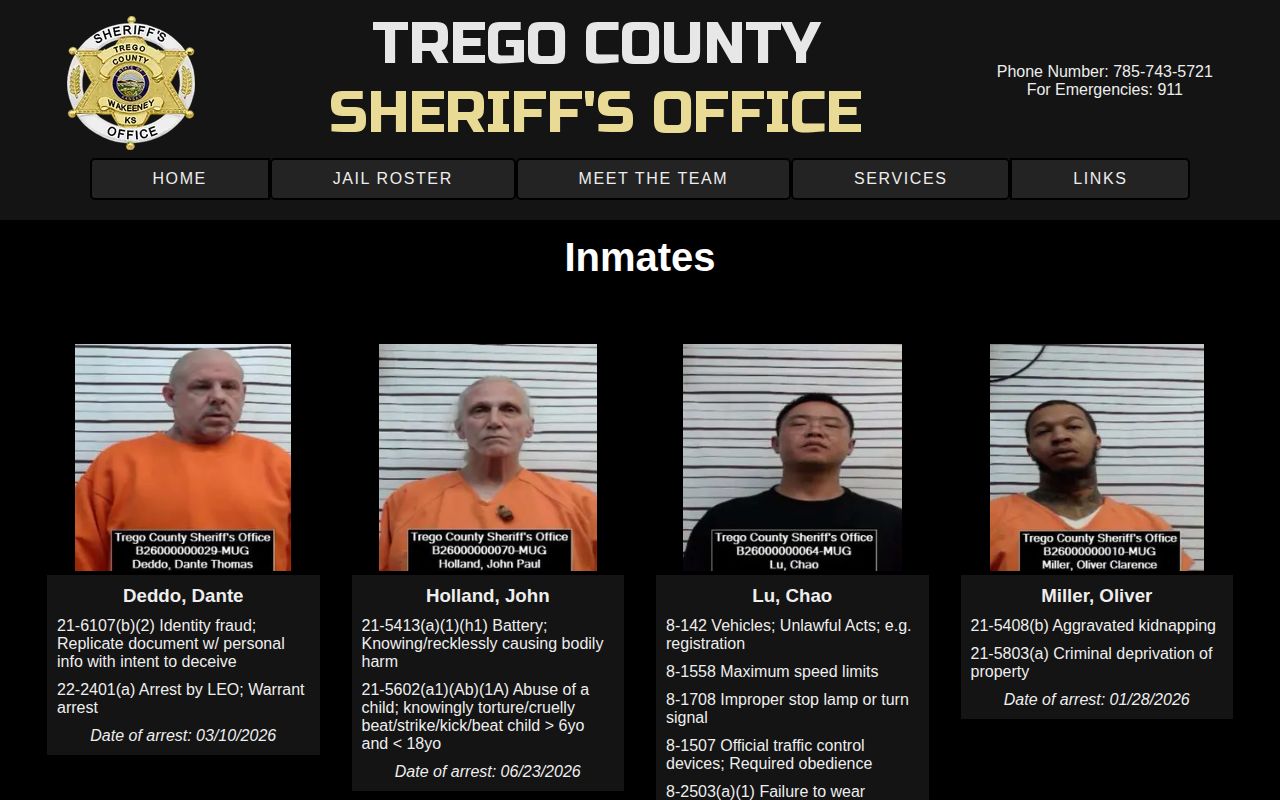
The image documents the interface, not a permanent status or released archive. The roster does not expose a released filter, release timestamp, rolling 24-hour or 72-hour window, cadence, archive, or released-photo collection.
| Evidence | Safe conclusion |
|---|---|
| Person listed on Trego roster | Trego reports current custody at the time checked |
| Person absent from roster | No current display; event remains unknown |
| Trego event log says release | Host recorded a release event and time |
| Trego event log names destination agency | Custody transferred rather than ending |
| Gove court order | Legal authority, not exact physical exit time |
For a past interval, request an existing release report or event log bounded by exact start and end times. Kansas law does not require an agency to create a new report that does not exist. Ask what fields an existing report contains and request public portions.
Trego and Gove Record Split
The distinctive Gove County issue is contract housing. Gove can originate the arrest and county record, while Trego creates the housing and physical movement entries. A person can leave Gove's immediate control without leaving Trego confinement. The official Gove housing page is the source for this two-agency trail.
When answers conflict, compare each agency's timestamp and wording. “Gove hold released” may mean only that Gove no longer requires detention. “Transferred from Trego” may identify movement to another jail or KDOC. “Released from Trego” still needs a destination check if another agency picked the person up.
This division also affects photographs. Ask both Gove and Trego which office owns the requested image and booking file. Kansas guidance permits discretionary closure of county arrest mugshots, so do not promise access. Request the image tied to the exact booking and ask for the statutory basis for any withheld portion.
Trego Release Court Checks
Gove County District Court records can explain why a person could leave Trego. Public entries may show bond, dismissal, sentence, time-served credit, probation, revocation, or a later order. They often remain available after a live host listing ends, but they do not ordinarily replace the jail's physical event time.
If Trego reports transfer to KDOC, use KASPER and read the exact status. An institution means continued confinement. Parole, conditional release, or postrelease supervision means prison exit with ongoing supervision. Discharged means the KDOC sentence ended. If KASPER has no result, the person may have had only county custody and should not be forced into the state-prison path.
VINELink may provide a county-jail status alert when the feeder participates, but an alert should be interpreted with Trego. Kansas VINE does not cover KDOC, juveniles, or federal detainees. A feeder-jail “release” can still be a transfer, so ask where custody went.