
BOP Federal Release Meaning
The BOP result guide says a location of RELEASED means the person is no longer in BOP custody. A past release date with no listed facility similarly indicates release on that date. That is a federal Bureau event, not a universal statement that the person entered the community.
A person may remain on federal supervision or enter state, county, ICE, or other custody. BOP's own release paperwork distinguishes a community destination from release to a detainer. A receiving detainer means custody continues elsewhere, so the next agency must be checked.
Search a Federal Prison Release
The BOP Inmate Locator covers federal inmates from 1982 to the present. An identifier search is usually the strongest route, while name search can require careful comparison.
- Search by BOP register, DCDC, FBI, or INS number when one is known.
- Otherwise enter first, middle, and last name, with optional race, sex, and age filters.
- Compare the name, register number, age, race, and sex to avoid a name-only mismatch.
- Read the location and release-date columns together.
- If the location says RELEASED, record the date and check whether another agency received the person.
A future date is projected and may change. UNKNOWN means the term or date is not determined. IN TRANSIT is movement within custody, not release. The Gove County release guide should be used instead when the event remained at the county-jail level.
BOP Locator Release Fields
The official BOP locator displays a narrower set of fields than KASPER or the Thomas jail roster. The captured interface below is the federal source used for the release-label explanation.
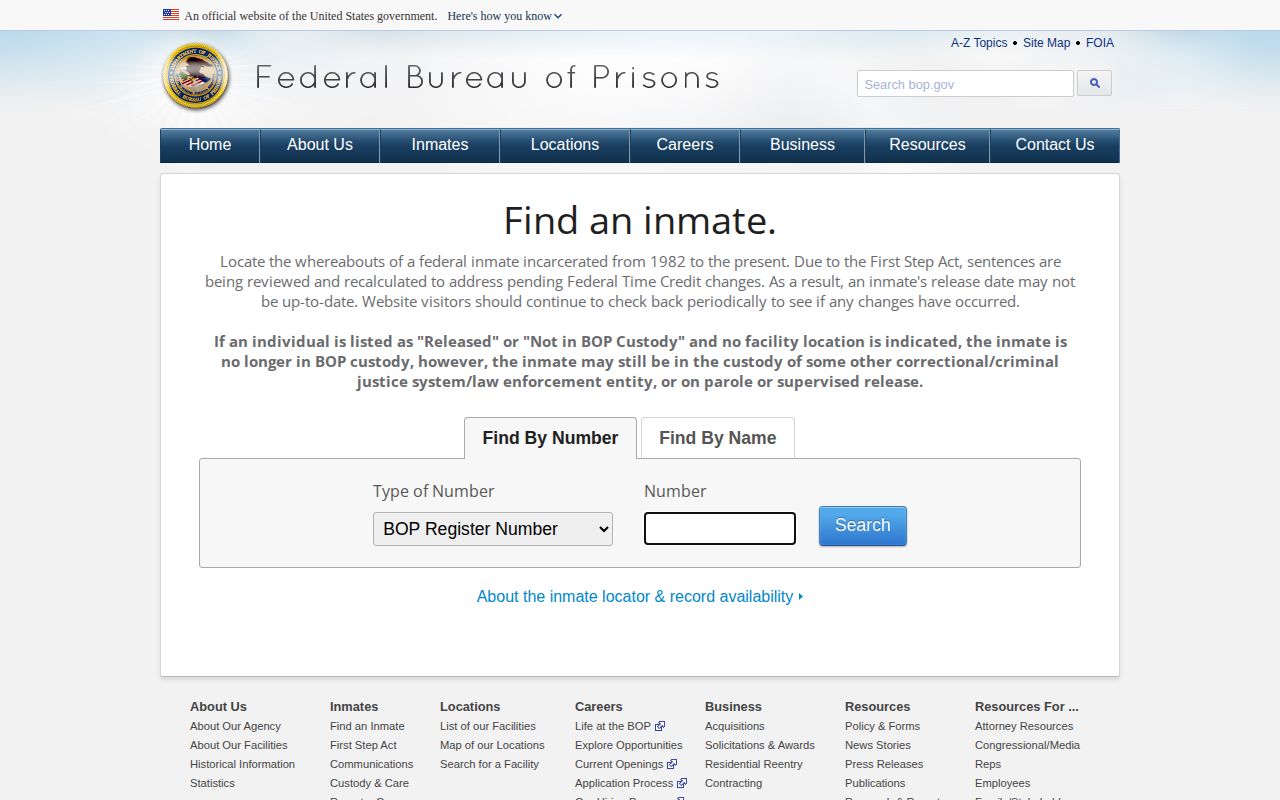
The image shows the locator design, not a permanent status for any person. Its strength is the federal date and location label, not photographs or county booking detail.
| Field | What it establishes |
|---|---|
| Name | Federal result identity |
| Register number | Stable BOP identifier |
| Age, race, and sex | Match support |
| Release date | Past federal event or future projection |
| Location | Facility, RELEASED, or another federal label |
The locator has no photograph. It also does not resolve later supervision or custody outside BOP. Save the exact displayed words and the date checked rather than paraphrasing the entry as “free.”
BOP Release Records Contact
BOP's public locator is the first route for a modern federal sentence. Its FOIA page is the records fallback when a locator result does not provide enough release detail. For a former prisoner before 1982, BOP directs researchers to National Archives records using the person's name, birth details, race, and approximate prison dates.
Federal Bureau of Prisons
Nationwide federal prison system
Online locator: BOP Inmate Locator
Records: BOP FOIA
Local note: no BOP institution surfaced in Gove County
Request an existing record tied to the register number and custody period. Useful fields include the actual release method, institution, date, community or detainer destination, supervision jurisdiction, and reporting obligation. BOP form BP-A0714 illustrates those distinctions, though the form itself is not proof about a particular person.
Ask for the public or segregable portion and keep BOP scope clear. A federal record should not be requested from Gove Sheriff merely because a prior local encounter occurred, and a Gove host release should not be searched as if it were a completed federal sentence.
BOP Projected and Actual Dates
A future BOP release date is not the same as an event already completed. BOP warns that First Step Act recalculation can leave a displayed date stale. Court action, sentence computation, credits, or placement changes can also affect what a reader expects.
When the date is in the past and the location is RELEASED, it supports the conclusion that BOP custody ended. When the date is future, call it projected. When the display says UNKNOWN, do not estimate. IN TRANSIT indicates continued movement within custody.
Federal release may lead to supervised release, which is court-ordered community supervision rather than BOP prison confinement. The locator does not provide a complete supervision record. Consult the federal court case or appropriate probation office for that separate status.
BOP Release to a Detainer
A detainer can direct BOP to hand a person to another authority at the end of the federal prison term. This is why RELEASED from BOP does not necessarily mean community release. The federal Bureau's custody can end at the same moment county, state, or immigration custody begins.
| Destination | Next source |
|---|---|
| Community | Federal court and probation record for supervision |
| Kansas custody | KASPER or the named Kansas jail |
| Another county or state | Receiving corrections or jail agency |
| ICE | ICE ODLS and detention information line |
| Unknown detainer | BOP record and the documented receiving authority |
The destination is essential to the phrase “where did the released prisoner go?” Without it, the federal date describes only the boundary of BOP custody.
Gove Cases and BOP Custody
No federal prison was identified in Gove County, but a person with a Gove connection can enter federal custody elsewhere. The federal path should begin only when the case, host, or federal record identifies that system. A pickup by USMS is not automatically a BOP placement because Marshals manage federal detainees before sentence and commitment.
If Trego or Thomas says USMS took the person, use the federal docket, counsel, relevant Marshal district, and actual contract holding facility. No general public USMS detainee locator was identified. Once the person is sentenced and committed to BOP, the BOP locator becomes appropriate.
If a Gove host roster disappears while BOP has no result, that mismatch does not prove release. The person may be in USMS pretrial custody, another jail, ICE, or outside federal coverage. Follow the exact agency named in the host event.
Gove's Host-to-Federal Trail
Gove County's local custody is already divided between the sheriff and contract hosts. A later federal handoff adds another boundary. Someone may leave Gove's legal hold, leave Thomas or Trego physically, enter USMS detention, and later appear in BOP after sentence. Each point has its own custodian and meaning.
The distinctive contract arrangement makes a host name and destination especially important. A missing Gove-linked roster entry cannot establish federal community release. The host event must first show which federal agency assumed control, then the correct federal source can be used.
BOP should never be described as a Gove facility. It is a nationwide system with no local institution found in the official sweep. Its role on this site is downstream federal verification for the smaller set of people whose custody actually entered the Bureau system.
Federal Release Locator Limits
The locator generally begins with 1982 records, has no photograph, and cannot explain every later custody or supervision event. Name spelling and aliases can affect results. A no-result may point to pre-1982 custody, USMS detention, immigration custody, a different identifier, or a person who was never in BOP.
VINELink does not cover federal detainees. KASPER does not cover BOP sentences. A Gove or host roster does not preserve a federal prison release. These systems are alternatives only after custody type is identified, not interchangeable search boxes.
For a precise former-prisoner record, combine the locator with BOP FOIA and the federal docket. Label projected dates as projected, distinguish RELEASED from detainer destination, and avoid claiming the person has no supervision or custody elsewhere.