
Understanding Gove County Releases
“Released” describes the end of one custody event, not always the end of all custody. A person may leave a host jail for the community after bond, time served, dismissal, or another court-authorized disposition. The same person might instead leave because Trego or Thomas transferred custody to the Kansas Department of Corrections, another county, the U.S. Marshals Service, or immigration authorities. Those movements remove a name from a current jail roster, but only a community release means the person walked free from that event.
The Gove County Sheriff inmate-housing page identifies Trego and Thomas counties as contract hosts. That arrangement divides the record trail. Gove Sheriff may document the local arrest and responsible case. The host jail controls the physical booking and exit event. Gove County District Court may hold the order that authorized release, while KDOC maintains a later state-prison or supervision record. A sound check reconciles these sources instead of treating one missing roster name as final proof.
- Release
- A documented exit from a particular custody event.
- Transfer
- A change of custodian, not a return to the community.
- Discharge
- The end of a sentence or supervision obligation shown by the responsible corrections agency.
- Time served
- A court disposition crediting enough confinement to satisfy the custody term.
Gove County Release Paths
The legal authority and the next custodian determine where a Gove County release can be confirmed. Bond may permit exit once payment, paperwork, and every outside hold clear. A court can order release, dismiss a matter, impose probation, or credit time already served. A sentenced person may complete a county term. Another person may leave the host only because KDOC or a federal agency assumed custody.
| Exit type | Meaning | Best next source |
|---|---|---|
| Bond or court release | Community exit after all conditions and holds clear | Host jail and Gove County court record |
| Time served or sentence completion | Custody term has been satisfied | Release event plus judgment or commitment |
| Probation | Court supervision in the community | Court Services or community corrections |
| KDOC transfer | State custody begins or continues | KASPER offender search |
| Federal or immigration transfer | A federal custodian receives the person | BOP, ICE, or agency confirmation |
A release reason never substitutes for physical-exit confirmation. A judge’s order can precede processing, and a bond may be available while another hold still prevents departure. Ask for the event, exact time, releasing authority, and destination.
Why Gove Inmates Change Jails
Gove County’s contract-housing model is the defining search fact. The sheriff’s official site does not present a locally operated Gove County Jail. An arresting deputy can remain responsible for the case while Trego County Detention Facility or Thomas County Jail holds the person. Thomas roster language can even identify “Housing for Other: Gove County Sheriff’s Office,” which marks contract custody rather than a Thomas criminal case.
Start with Gove Sheriff when the host is unknown. Once identified, use the host roster only for a current-custody check. If the name is gone, call that host and request the last event. Community release, transfer, a court trip, hospital movement, death, escape, a data correction, and a temporary outage do not mean the same thing. The official host response is the bridge between the live roster and the lasting release record.
A person can leave Gove Sheriff’s immediate control and remain incarcerated elsewhere. Identify the physical host before interpreting any roster change.
Gove County Bond Release Checks
The Trego County roster page states that bonding is available around the clock by appointment. That tells a family how to reach a bond process at one possible Gove County host. It does not show that a specific bond was posted or accepted. Nor does it prove that jail staff completed release paperwork or cleared every detainer.
Confirm the named person, booking, bond authority, and appointment directly with the host. Then ask whether another agency has placed a hold. After the court and jail requirements are met, request the actual physical-exit time. The difference matters when a person is no longer visible online but has been transferred rather than released to the community.
The Trego roster screenshot shows the current-host format and its facility route. Visit the official Trego roster for the live version.
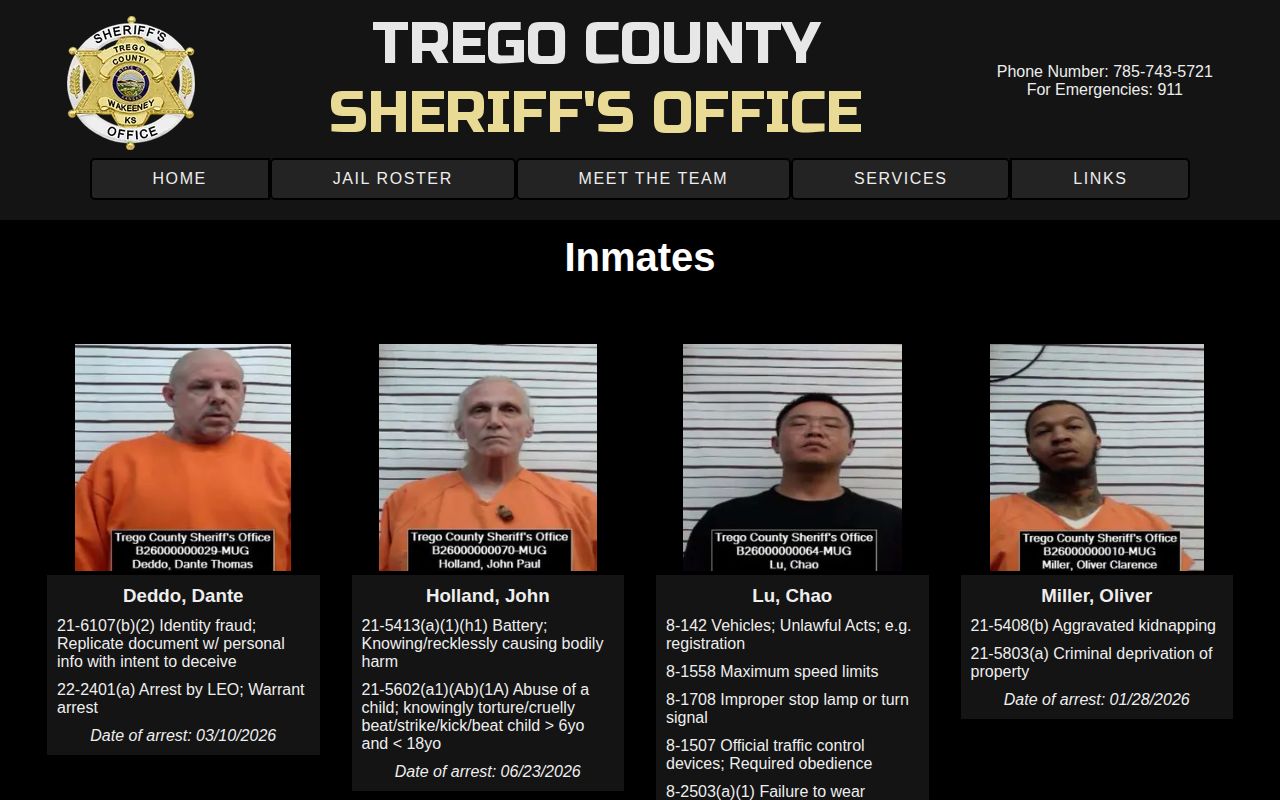
Read this image as evidence of a current roster and bond contact route, not as a list of Gove County released inmates.
Gove County Release Record Fields
No public Gove release form or downloadable archive is posted. A targeted request should ask for existing fields tied to one booking rather than require staff to answer a broad question or create a new report. The booking number is the best tie-back when known. A full name, date of birth, and approximate booking period can help distinguish people with similar names.
| Requested field | What it resolves |
|---|---|
| Booking number and date | Connects the release to the correct custody event |
| Physical host | Identifies Trego, Thomas, or another custodian |
| Release date and time | Shows when that facility’s custody ended |
| Release authority or reason | Connects bond, court order, sentence completion, or other basis |
| Destination or receiving agency | Distinguishes community exit from transfer |
| Bond or order reference | Links the physical event to its legal authority |
| Booking photograph | Identifies the image associated with that booking, if discloseable |
A host may hold the jail-management record while Gove holds the local incident or arrest record. Ask each office which agency is the custodian of the item sought. This avoids a denial based only on sending a valid request to the wrong office.
Request Gove County Release Records
Gove Sheriff accepts contact by phone, in person, and through its official contact route. The office is at 420 Broad Street, Gove, Kansas 67736. Its direct line is 785-938-2250, listed as available 24 hours, while administrative hours are Monday through Friday, 8:00 a.m. to 5:00 p.m. Use the host jail as well when the sought record concerns physical booking, property, or exit.
- Identify the person with full name, date of birth, booking number if known, and an approximate date range.
- Ask Gove Sheriff which contract facility held the person and which office keeps each requested item.
- Describe existing records or fields, including the release event, time, authority, destination, and booking photograph.
- Send the same bounded request to Trego or Thomas when that host controls the jail record.
- Ask for the legal basis if material is withheld, and request any segregable public portion.
The research found no posted Gove release-record fee, fixed response time, or retention schedule. Do not assume one. Kansas open-records law permits agencies to respond under the governing facts and available records. Ask about cost before copies are made, and keep the request narrow enough to locate without forcing creation of a new record.
Gove County Sheriff’s Office420 Broad Street
Gove, KS 67736
785-938-2250
Administrative hours: Monday-Friday, 8:00 a.m.-5:00 p.m.
Kansas Law on Gove Releases
The Kansas Open Records Act begins with public access but includes specific exemptions. Jail rosters are treated differently from criminal-investigation records, while mugshots and some standard arrest material may be closed at agency discretion. Correctional fields held by KDOC have their own rules. A request should therefore name the particular release or booking field instead of assuming every part of one file has the same status.
K.S.A. 22-4705 treats release from detention or confinement as a reportable criminal-history event. That does not create a public, real-time Gove release feed. It does explain why the event can survive after a live host roster changes. Juvenile, sealed, and protected information may not appear through public channels.
Under K.S.A. 21-6614, an expungement can restrict disclosure of a qualifying conviction or diversion. Expungement does not mean every distributed copy vanishes at once, and eligibility depends on the case. The court file and originating custodian control whether a record is sealed, expunged, or publicly available.
Gove Court Release Evidence
Gove criminal matters run through Gove County District Court in the 23rd Judicial District. The district record-search instructions lead to the Kansas case portal, where public dockets and documents may preserve bond, disposition, sentence, probation, revocation, jail-credit, satisfaction, or discharge context after a host roster drops the name.
A court event is legal authority, not proof of the minute someone walked out. Compare the filed order with the host’s physical-exit record. Sealed, expunged, juvenile, and other protected material will not be public. Some documents also require courthouse access under Kansas court-record rules.
The official Kansas case search illustrates the party and case lookup route.
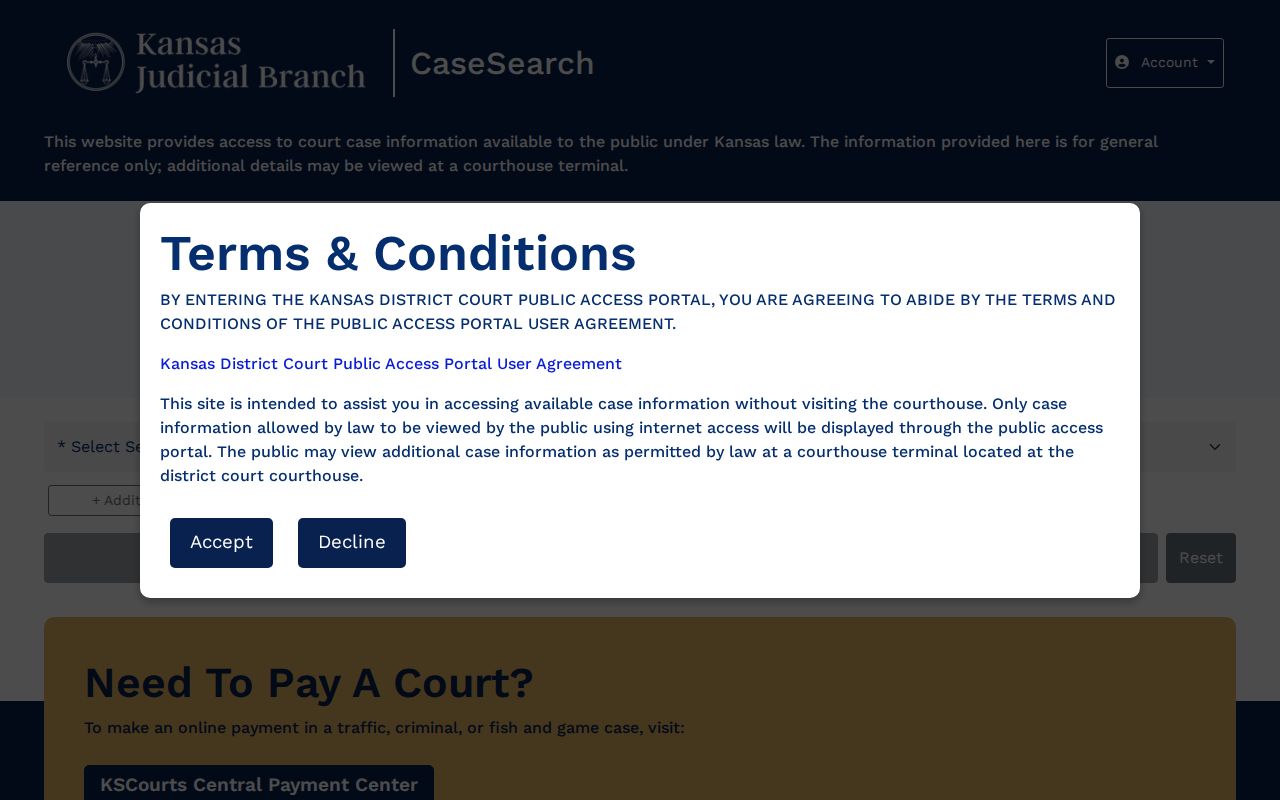
The court result can explain why custody ended, while Trego or Thomas remains the source for the actual jail exit.
Find a Released Gove Inmate
A complete Gove County released inmate search moves from the local case to the physical host and then to any downstream custodian. There is no official Gove recent-release feed to search first. Trego and Thomas publish current rosters only. Use those lists to test whether someone is still reported in custody, never to prove release from absence.
- Call Gove Sheriff and identify which contract county housed the person for the local event.
- Check the Trego or Thomas current roster, using a booking number when available.
- If absent, ask the host for the last custody event, exact timestamp, release authority, and destination.
- Check the Kansas court record for bond, disposition, sentence, probation, or transfer authority.
- Search KASPER if the host says KDOC received the person or if a state sentence may apply.
- Use Kansas VINE for a participating county-jail notification, or the correct federal locator for federal custody.
- Request the existing release report when online sources cannot settle the event.
A missing name proves only that the live roster no longer reports current custody. Confirm release, transfer, or correction with the host.
For a bounded same-day inquiry, the Gove County 24-hour release list process explains how to request an interval when no feed exists.
KASPER Gove Release Search
The Kansas Department of Corrections operates KASPER for people in KDOC-operated or funded custody since 1980. It is not a Gove booking archive. When a host confirms transfer to KDOC, KASPER can retain a person after jail removal and after prison release. A record may show anticipated release, location and movement dates, parole or postrelease context, a supervision office, and discharge information.
| Search or result field | Use |
|---|---|
| Name or KDOC number | Finds and distinguishes a state record |
| County and case | Connects a conviction to Gove County when applicable |
| Location and movement dates | Shows changes within the KDOC system |
| Anticipated release date | Reports a prospective date, not a guarantee |
| Supervision office and level | Helps verify parole or postrelease supervision |
| Discharge context | Shows when KDOC authority ended where disclosed |
KASPER warns about working-day updates and limits for community-corrections probation events after April 21, 2021. A no-result does not rule out a county-only booking. Accept the disclaimer at the official KASPER search, compare identity fields, and use court or agency records when the status remains unclear.
The official KASPER entry screen documents the scope of the state search.
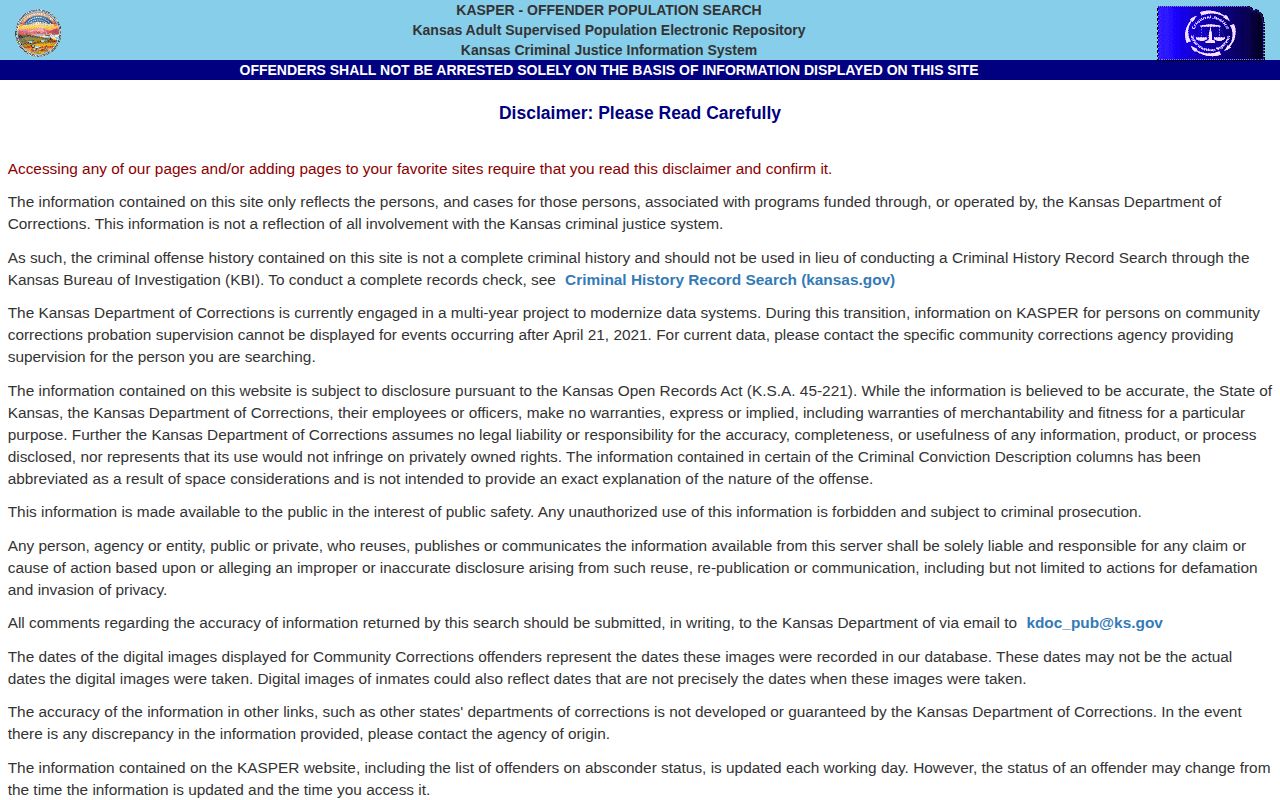
It should be used only after separating a KDOC record from a county-host custody event.
Gove Recent Release Records
Gove Sheriff publishes no 24-hour or 72-hour release view in its official navigation. Trego and Thomas show current detainees, not released archives. The 23rd District docket page offers jail logs for several counties but not Gove. Combining two roster snapshots and calling every missing name “released” would mislabel transfers and corrections.
Define the interval in Central Time and contact both possible hosts when necessary. Ask whether the person was held for Gove during that interval, what the final custody event was, when it occurred, and which agency received the person if it was a transfer. Request an existing event or release log and deduplicate any returned entries by person and booking number.
Gove Post-Release Supervision
Parole, postrelease supervision, and probation are different legal statuses. KDOC Parole Services handles parole and postrelease field supervision. Court Services and Northwest Kansas Community Corrections handle probation paths tied to the judicial district. KASPER can show some state supervision fields, but it warns that later community-corrections probation events may be incomplete.
Verify the type of supervision in the sentencing record first. Then contact the correct regional office or KDOC source. A parole absconder result is not a release list, and absence from that search does not prove discharge. The full verification route appears on the Gove County parole and probation page.
Gove Release Alerts and Federal Checks
Gove Sheriff refers users to VINELink. Kansas VINE covers participating county jails and can report release, transfer, or other status changes from the feeder facility. It does not cover KDOC prisoners, juveniles, or federal detainees. In a contract-housing county, match the person to Trego or Thomas and call the host when an alert does not distinguish community release from transfer.
For a former federal prisoner, the BOP inmate locator can show “RELEASED” and a release date. That result covers federal custody only and may not resolve a later detainer or supervision status. ICE’s locator can retain recently released records for a limited period, while the U.S. Marshals Service has no general public detainee locator. No result from a federal tool proves nothing about an ordinary Gove County jail event.
Gove Custody Versus Release Sources
Choose the source by custody type and by the question being asked. Current rosters answer who a host reports now. Release records answer what ended a past event. Court files explain legal authority. State and federal systems cover only people who entered those systems.
| Source | What it can show | Critical limit |
|---|---|---|
| Trego or Thomas roster | Current host custody | Absence is not proof of release |
| Gove and host release records | Exit time, reason, authority, destination | May require a targeted request to both custodians |
| Kansas court portal | Bond, disposition, sentence, probation | Legal event may precede physical exit |
| KASPER | KDOC custody, movement, release, supervision, discharge | Not a county booking archive |
| VINELink | Participating county-jail status and alerts | No KDOC, juvenile, or federal coverage |
| BOP or ICE locator | Federal custody or qualifying recent ICE record | Does not cover an ordinary county release |
Was the person released because the name vanished? Not necessarily. Roster removal must be reconciled with the host’s last event and destination.
Gove County Custody Facilities
Gove Sheriff is the local booking and law-enforcement agency, but it contracts for inmate housing. Trego County Detention Facility and Thomas County Jail are the named physical hosts. KDOC becomes relevant after a state commitment. BOP, ICE, and the U.S. Marshals Service apply only when a federal custodian is involved.
- Gove County Sheriff’s Office: identify the host and local release-record custodian.
- Trego County Detention Facility: confirm current custody or the exact exit event.
- Thomas County Jail: check current contract housing and ask about release versus transfer.
- Kansas Department of Corrections facilities statewide: use KASPER for state custody, release, or discharge.
- Federal Bureau of Prisons facilities nationwide: use the BOP locator for federal records.
- ICE / U.S. Marshals custody: use the correct federal agency route and understand locator limits.
Each facility page follows the release path appropriate to its operator. A state-prison discharge should never be described as a county-jail release, and an ICE transfer should never be presented as a return to the community.